

Priming VIRANIX pre-mixed stone carpet — durability is decided by the first layer
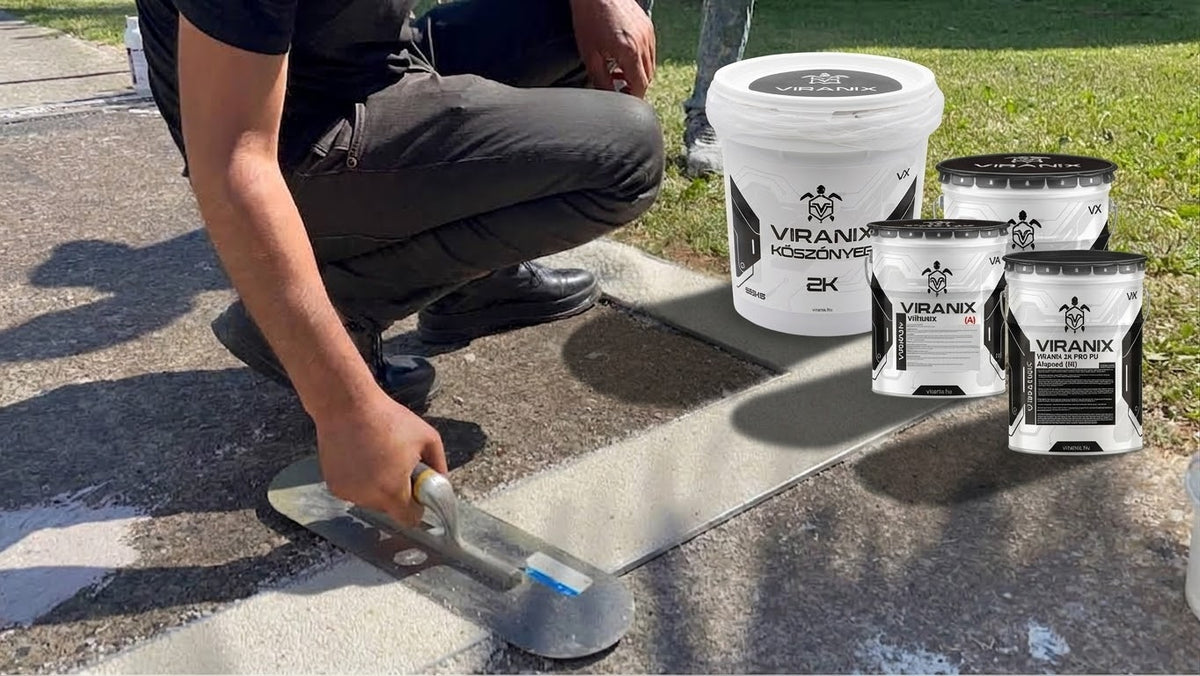
The look of a beautiful stone carpet surface comes together in minutes, but its durability depends on the priming. In the VIRANIX system we use the one-component, factory pre-mixed TERRALOCK 1K primer — no components to combine and no thinning: simply stir it briefly and apply it in a thin, closed film.
Contents
- Why is priming mandatory?
- Mandatory measurement limits
- Tools and materials
- Surface preparation — a fail-safe routine
- Application protocol
- Curing time and next steps
- Material consumption and planning
- Typical mistakes — sign, cause, fix
- Substrate-specific guide
- Topcoat and water protection
- QA and documentation
- Frequently asked questions
1. Why is priming mandatory?
- Bonding bridge: it anchors itself into the pores of the substrate at micro level, which gives the stone carpet layer its lasting adhesion.
- Evening out absorbency: it creates a uniform surface so the stone carpet layer is not absorbed unevenly in patches.
- Vertical stability: on walls and plinths it helps hold the fresh material in place while it cures.
- System reliability: the stone carpet layer and the topcoat may only be applied to a dry, homogeneously primed surface.
2. Mandatory measurement limits
| Substrate moisture content | max. 9% (never on rising ground moisture) |
| Substrate pH | max. 10 |
| Air temperature | between +10 °C and +30 °C |
| Relative humidity | max. 80% |
| Dew point | surface temperature at least 3 °C above the dew point |
Measure, record and take photos — this is part of professional work and serves as evidence in case of a dispute.
3. Tools and materials
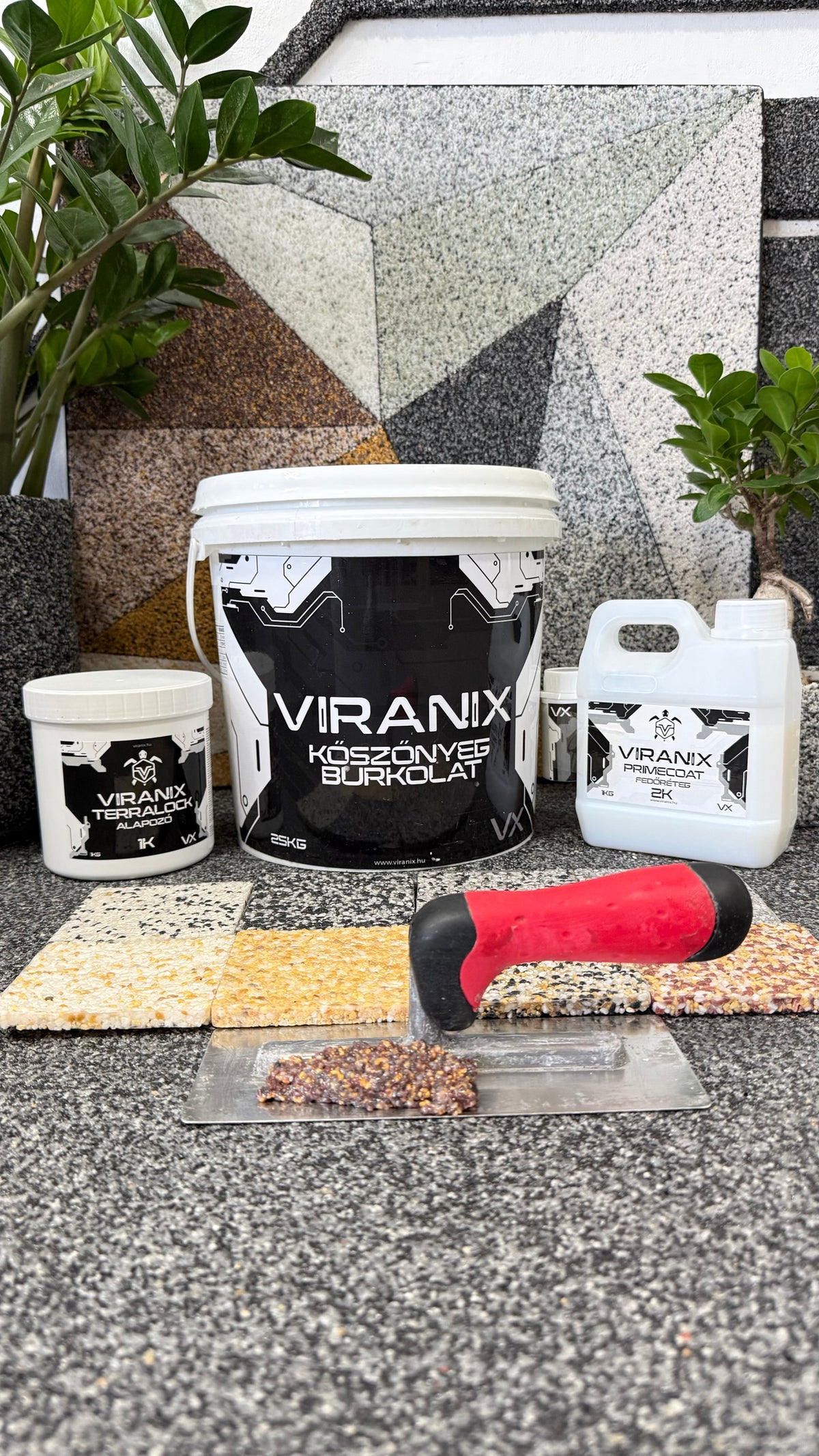
- Material: VIRANIX TERRALOCK 1K — one-component, factory pre-mixed primer, ready to use after a brief stir.
- Application: medium-pile paint roller, 50–70 mm brush for corners and edges.
- Preparation: industrial vacuum cleaner, protective sheeting, masking tape, spatula.
- Measurement: CM meter, pH test, thermometer/hygrometer for dew point calculation.
- Cleaning: a cleaning agent compatible with the uncured material, rinse with clean water.
- Protective equipment: safety goggles, chemical-resistant gloves; ensure good ventilation indoors.
4. Surface preparation — a fail-safe routine
- Dust removal: with an industrial vacuum cleaner — dust is the number one enemy of adhesion.
- Degreasing: traces of oil, paint or rubber must be removed by local grinding and a degreaser.
- Defect repair: remove and repair cracks, craters or loose layers before priming.
- Roughening: surfaces that are too smooth or glossy (e.g. glazed wall or floor tiles) must be roughened by grinding to ensure proper adhesion.
- Masking: protect edges, expansion joints and connections before starting work.
- Measuring and documenting: record substrate moisture, pH, temperature and humidity, ideally with photos.
5. Application protocol
- Cutting in the edges: with a brush at corners, penetrations and edges.
- Rolling flat areas: from a roller tray, using cross-rolling — first lengthwise, then crosswise.
- Layer thickness: a thin, closed film — no puddles, no glossy areas.
- On highly absorbent substrates: two thin coats are needed, always after the first coat has fully cured.
- Self-check: inspect the surface under raking light and look for missed strips or glossy, puddled zones.
6. Curing time and next steps
- Visual sign: the surface is matt and uniform.
- Touch sign: dry, not tacky, leaves no mark on a glove.
- Time window: typically 4–12 hours, depending on the climate.
- Next step: the stone carpet layer may only be applied to fully cured primer.
- If 24–48 hours have passed: settled dust may need to be removed again before applying the stone carpet layer.
7. Material consumption and planning
| TERRALOCK 1K primer | ~0.15 kg/m² · 1 coat, by roller |
| PRIMECOAT 2K topcoat | ~0.30 kg/m² · 2 coats, by roller |
These are net consumption figures for a flat surface. For the actual job, the installer may add an allowance at their own discretion to account for surface irregularities.
Example calculation — 20 m² terrace, standard concrete substrate:
- Primer: 0.15 × 20 = 3.0 kg
- Topcoat: 0.30 × 20 = 6.0 kg
8. Typical mistakes — sign, cause, fix
-
Primer applied too thickly
Sign: glossy, puddled, tacky surface. · Cause: thick, paint-like application. · Fix: after full cure, light sanding followed by a thin corrective coat. -
Missed strip
Sign: local delamination later on. · Cause: cross-rolling skipped. · Fix: remove dust, then apply a thin repair coat of primer. -
Whitening, pinholes
Sign: milky spots. · Cause: high humidity or a surface close to the dew point. · Fix: ventilate, then repair and re-prime the affected area locally. -
Poor adhesion
Sign: comes off in a tape test after 24 hours. · Cause: dust, grease, high pH or moisture content. · Fix: degrease/grind, measure again, re-prime. -
Moving on too early
Sign: sinking grains, uneven curing. · Cause: the primer had not yet cured. · Fix: grind back the affected area, re-prime and wait.
9. Substrate-specific guide
- Concrete / cement screed: remove laitance and dust thoroughly; moisture content max. 9%, pH max. 10, no rising ground moisture. Smooth-troweled zones must be roughened.
- Calcium sulfate (anhydrite) screed: particularly sensitive to moisture — measuring the moisture content is critical, and grinding the surface layer is mandatory.
- Ceramic tiles: degrease thoroughly; glossy, glazed surfaces must be matted by grinding, and the grout joints must also be cleaned thoroughly. Then apply the quartz-sand BETOGRIP bonding bridge, followed by TERRALOCK 1K.
- Renovating an old stone carpet surface: activate the surface by grinding, then remove the dust; a test area is recommended.
- Walls, plinths, stairs: work with a brush first, then with a roller — the texture of the primer helps hold the fresh material on vertical surfaces.
10. Topcoat and water protection
VIRANIX stone carpet is a water-based binder system — without a topcoat the surface remains more open, which is why final water protection always comes from the topcoat. The topcoat is mandatory in every application, not an optional extra.
- PRIMECOAT 2K: the standard sealing for 1K stone carpet, both indoors and outdoors. It creates a closed, easy-to-clean surface; it does not replace waterproofing.
- PRIMECOAT 2K PRO: mandatory in every case on surfaces with vehicle traffic (carports, driveways) — a basic requirement for load-bearing capacity and surface protection.
11. QA and documentation
Before installation
- Moisture content (max. 9%) and pH (max. 10) measured and recorded
- Temperature, humidity and dew point documented
- Photo of the prepared substrate
After priming
- Matt, closed film — no glossy or puddled areas
- Dry to the touch, leaves no mark on a glove
- Corners, expansion joints and penetrations covered
- 24-hour tape test: the layer does not come off
- Photo of the finished primed surface
Before moving on
- Remove dust again after 24–48 hours
- Re-check weather/climate conditions
12. Frequently asked questions
Does it really have to be applied in a thin layer?
Yes. The primer is a bonding bridge — applied thickly, it cures more slowly, stays tacky and can cause defects. On highly absorbent substrates, two thin coats are the right solution rather than one thick coat.
What is a realistic primer consumption?
The guide value is approx. 0.15 kg/m² on a standard concrete substrate.
When can I apply the stone carpet layer?
When the primer is matt and completely dry to the touch — typically 6–12 hours, depending on the climate.
Is it suitable for an uncovered terrace? Is it frost-resistant?
Yes, with the right layer build-up: correct slope, professional priming and a complete topcoat specified for outdoor use (PRIMECOAT 2K) together ensure that no continuous water film remains on the surface that could cause damage when it freezes.
Final summary
- The VIRANIX primer is factory pre-mixed — stir briefly, then correct application is what counts.
- No quality without measurement: moisture content, pH, temperature, humidity, dew point.
- Always a thin, closed film — on absorbent substrates two thin coats, not one thick one.
- The topcoat is mandatory in every case — it provides the final water protection of the surface; PRIMECOAT 2K as standard, PRIMECOAT 2K PRO for vehicle traffic.
Share:
What actually makes a stone carpet surface strong?
1 comment
Tiszteletem!
Tudnak-e ajánlani szakembert, aki a leírt módon képes dolgozni ezzel az anyaggal? Budapesten lenne szükség egy 8 nm-es terasz felújítására. Valamint mit javasolnak? Szükséges felszedni a felfagyott járólapot?
Köszönöm szépen a segítséget!