

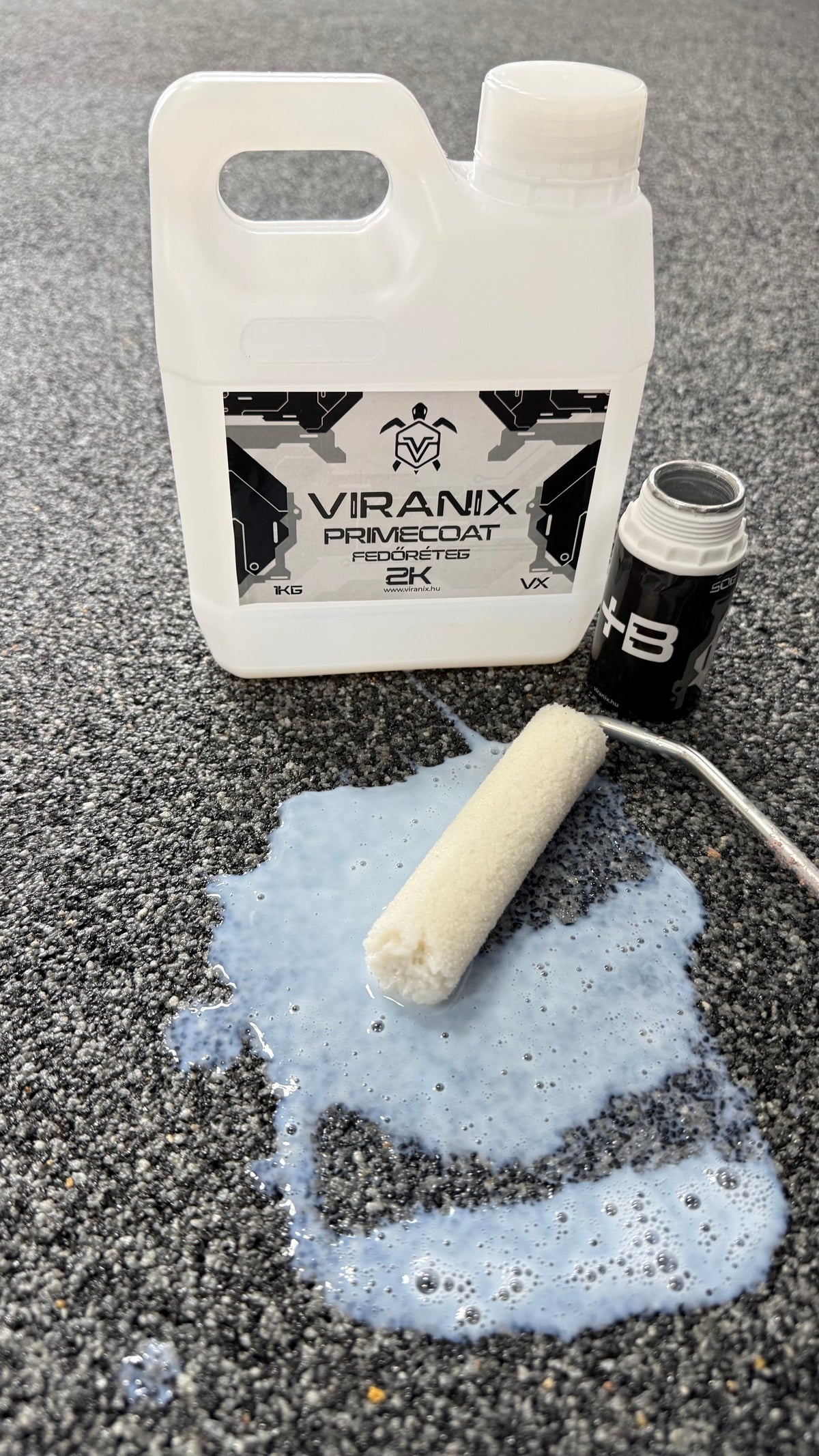
The stone carpet is finished, and it looks beautiful. Now comes the roughly 300 grams per square meter that decides how it will still look years from now.
In this guide we walk you through applying the VIRANIX PRIMECOAT 2K topcoat, from weighing out to the first 24 hours. We show you not only what to do, but also what happens inside the layer while you do it: why a patch turns milky, where bubbles come from, and why you must never go back over a partly cured area.
Two invisible processes everything depends on
Before we open the containers, it is worth taking a minute to “look inside” the layer. Once you have this picture in mind, most of the rules become self-evident – there is no need to memorize them.
PRIMECOAT 2K is a two-component, aliphatic polyurethane topcoat. Component “A” is the water-based binder, component “B” is the hardener. As long as they are kept apart, nothing happens. But the moment you mix them, the clock starts ticking, and two processes have to run their course undisturbed.
Water leaving the layer
The freshly applied coat contains water, which is why it looks whitish and milky. As the water evaporates, the layer clears and becomes transparent.
Chemical curing
Components “A” and “B” react with each other to build a dense, cross-linked structure. This is what makes the layer hard, abrasion-resistant and water-resistant.
There is also a third player. A small part of the hardener reacts not only with the binder but also with water, and this produces tiny carbon dioxide bubbles. From a thin layer they escape without any problem. From a thick layer, in humid air or from a surface that skins over too quickly, they cannot: they stay trapped as bubbles, pinholes or milky patches.
The key point in one sentence: almost every application defect can be traced back to something preventing water and gas from escaping, or disturbing the curing. The following chapters go through when and how this happens, and how you can prevent it.
1 Patience: when can the topcoat go on the stone carpet?
Suppose the stone carpet was finished on Thursday. By Friday it is already walkable, the surface looks dry, the color is beautiful, and rain is forecast for the weekend. The temptation is huge: “I’ll quickly seal it before the rain comes.” This is exactly the moment when many later problems are born.
The binder of VIRANIX stone carpet is also water-based. Its surface sets relatively quickly and becomes walkable – at 20 °C usually after 24–48 hours – but water keeps escaping from the deeper parts for days. Indoors, and in cooler or more humid weather, full cure can take as long as 4–5 days. Just because the surface looks dry does not mean it is dry underneath.
What happens if moisture gets trapped?
PRIMECOAT 2K seals the surface – that is exactly its job. But if there is still water in the stone carpet underneath, the topcoat acts like a lid on a pot: the vapor cannot escape and collects at the boundary between the two layers.
The consequences
- milky, opaque, whitish discoloration that does not clear even after curing,
- blistering, with the topcoat lifting in places,
- weaker adhesion between the topcoat and the stone carpet,
- because of the trapped water, the stone carpet’s binder also cures more slowly and less completely.
Rule of thumb: if in doubt, wait one more day. A day of waiting costs nothing, but repairing a surface that has turned milky because of trapped moisture costs a lot.
Before you start, the stone carpet must be clean and dust-free: vacuum it thoroughly. Whatever stays on the surface will stay there for good, sealed into the fresh layer.
2 Weather: when can you apply the topcoat?
It’s Saturday morning, the sun is blazing, and 31 degrees is forecast for the afternoon. A perfect day to work on the terrace, you might think. For the topcoat, however, this is one of the worst scenarios: PRIMECOAT 2K doesn’t need nice weather, it needs the right weather. Before you mix, check these six things:
Temperature
between +10 and +30 °C
Below this range, water escapes slowly, curing is delayed, the surface stays tacky for a long time and every speck of dust sticks to it. Above it, the layer “bakes” – more on this below.
Humidity
max. 80%
In humid air, water cannot evaporate: the layer clears slowly, may stay milky, and more gas bubbles form.
Rain
keep it off for 24 hours
On a layer that has not yet cured, raindrops leave white dots, water marks and tiny craters.
Direct sun
avoid
Stone carpet in the sun can be much warmer than the air: even on a 25-degree day, its surface can easily heat up to well over 30 °C.
Dew
dry surface
In the early morning and evening, moisture condenses on the cooling surface. It is barely visible, but sealed into the fresh layer it behaves just like rain. Rule of thumb: the surface should be at least 3 °C warmer than the dew point.
Wind and dust
still air
Wind carries dust, pollen and leaves into the fresh, tacky layer and speeds up curing unevenly.
What happens above 30 °C, when the layer “bakes”?
In hot weather, water evaporates faster and the chemical reaction also speeds up. At first this sounds like good news. The problem is that the top of the layer skins over before everything underneath has been able to escape, and the water and gas trapped below lift or burst through this thin skin.
Signs of this
- bubbles and tiny pinholes,
- roller marks and streaks, because the fresh material can no longer flow together nicely with the strip that has started to set,
- patchy, uneven gloss,
- discoloration: milky, grayish or differently shaded patches,
- and the material thickens faster even in the mixing container, so you have less time to apply it.
Summer tip: the thermometer measures the air, not the floor. In summer, work in the morning, once the dew has dried but before the surface has heated up, or in the late afternoon, when the surface is in the shade and has cooled down, but well before the evening humidity sets in. And don’t leave the containers in direct sun: material that has warmed up thickens faster after mixing.
In the first chapter, the water came from below, from the stone carpet. In humid weather, on a dewy surface or in rain, the same thing happens from above: water gets into the layer before it has cured and causes the same symptoms.
3 Weighing out at 20:1 and mixing
The videos show the process clearly: the empty mixing container goes on the digital scale, we tare it (reset the scale to zero) and weigh out component “A”. Then comes component “B”, the hardener, at a 20:1 ratio by weight. In other words, for every 20 grams of component “A” there is 1 gram of “B”.
If you mix the entire pack at once, this is approx. 953 g “A” + 47 g “B” for the 1 kg pack, and approx. 9.53 kg “A” + 0.47 kg “B” for the 10 kg pack. For partial batches, this table will help:
| Component “A” | Component “B” (hardener) |
|---|---|
| 100 g | 5 g |
| 200 g | 10 g |
| 300 g | 15 g |
| 500 g | 25 g |
| 1,000 g | 50 g |
The amount of component “B” is always one twentieth of the weight of component “A”.
Why does every gram count?
Too little hardener
There are not enough “partners” for the network: the layer may stay soft and tacky and will not reach its final hardness and resistance.
Too much hardener
It does not make the layer stronger. The excess reacts with water, more gas bubbles form, and the layer can become cloudy and more brittle.
That is why we work with a scale, not by eye. A digital kitchen scale accurate to one gram is perfectly adequate.
Mixing: thoroughly, but slowly
Mix the two components at low speed for 2–3 minutes until you get a homogeneous, lump-free material. Scrape the sides and bottom of the container too, because unmixed material can remain there. For small batches use a stirring stick; for larger ones, a mixing paddle on a low-speed drill. Mixing too fast, as if whisking, beats air into the material, which later shows up as bubbles on the surface.
Mixed material does not wait. The pot life is approx. 30–40 minutes, shorter in hot weather: the reaction is also running in the mixing container, and material that has thickened no longer flows out nicely. Only mix as much at a time as you can definitely apply within this time.
How much topcoat does the stone carpet need?
Allow approx. 150 g/m² of mixed material per coat; for two coats, this adds up to approx. 0.30 kg/m².
| Area | 1 coat | 2 coats in total |
|---|---|---|
| 1 m² | 0.15 kg | 0.30 kg |
| 5 m² | 0.75 kg | 1.5 kg |
| 10 m² | 1.5 kg | 3 kg |
| 20 m² | 3 kg | 6 kg |
| 33 m² | approx. 5 kg | approx. 10 kg |
The quantities refer to the mixed (“A” + “B”) material. In two coats, a 1 kg pack covers approx. 3.3 m² and a 10 kg pack approx. 33 m².
4 The first coat: thin, even, and never go back
Now for the key part. Apply the mixed material with a short-pile roller, and do not pour it onto the surface: dip the roller into the material and feed it onto the stone carpet that way. Go over each area at least four times with even, crosswise strokes, so that the material reaches everywhere, deep into the pores, but no excess is left anywhere.
The freshly applied material is whitish and milky. Don’t be alarmed – that’s the water in it: as it escapes and the layer cures, the surface clears and the original color of the stones comes through.
What happens if a puddle is left in one spot?
It seems convenient to simply pour out the mixed material and spread it from there. The trouble starts when the poured batch sits in one place for a while before you spread it, or when puddles are left in the hollows of the stone carpet.
There, the layer is several times thicker than around it. In the thin areas the water and gas escaped long ago, but in the puddle they are trapped: its surface cures and everything underneath is locked in.
Signs of a puddle
- a milky, opaque patch that does not clear,
- bubbles, a foamy structure,
- a softer center that cures more slowly,
- a glossier, “plasticky” island in a matt surrounding.
That is why we dip the roller instead of pouring. If excess still collects in the hollows, spread it out with the roller while the material is fresh.
Why don’t we go back over a partly cured area?
You’ve finished a strip, you look back and spot a missed patch or a streak. Your first reflex: quickly go over it once more with the roller. Don’t.
After a while – sooner in hot weather – a thin skin starts to form on the surface of the fresh layer: the material starts to drag and becomes tacky. If you go back over it at this point, the roller tears this skin. In the damaged area the layer turns cloudy and streaky, roller marks remain, and fibers and bubbles get into it. The attempted repair leaves a bigger mark than the defect itself.
1. Fresh, wet
Can be worked freely: roll it crosswise now, even several times.
2. Starting to drag, tacky
Don’t touch it! Every touch leaves a mark on the skinning surface.
3. Set, no longer tacky
The second coat will take care of small gaps.
So there is no need to rush with a missed patch: that is exactly what the second coat is for.
How to work: in sections, with a wet edge
- Before you start, mark the section boundaries (door line, profile, corner), and always finish one clearly defined section at a time.
- Always work towards the fresh, wet strip (wet edge), so the strips flow together and no overlap is visible.
- Go over each area at least four times crosswise, with even pressure, while it is fresh.
- Work towards the exit so you don’t have to step on the fresh layer.
- In hot weather, work in smaller sections, because the material starts to drag sooner.
5 The second coat: once the first has set
Only apply the second coat once the first has set: it is no longer tacky to the touch, and its surface has cleared evenly. If it goes on too early, the two coats behave like one thick coat, and you get all the problems of a puddle back.
Apply the second coat exactly like the first: with a dipped roller, thinly, using crosswise strokes. This way the two coats even out each other’s small irregularities, and missed patches get covered too.
Why are two thin coats better than one thick one?
| 1 thick coat | 2 thin coats | |
|---|---|---|
| Water and gas escape | with difficulty, slowly | easily |
| Bubbles, pinholes | common | rare |
| Milky, opaque patches | high risk | uncommon |
| Puddling | common in hollows | avoidable |
| Curing | slow, uneven | even |
| End result | may be patchy | even, clear |
One thick coat is not twice as strong – it is twice as risky. From the same amount of material, two thin coats give a more even, clearer and more durable surface.
6 The first 24 hours: rain protection and load capacity
You’ve put down the roller, and the surface looks great. But the bigger part of the work only starts now – except it’s not you doing it, it’s the chemistry. During this period the layer is still vulnerable.
-
For 24 hours after application
No rain must reach it. Also protect it from humidity, dew, dust and falling leaves. -
After approx. 24 hours (20–22 °C)
Carefully walkable. -
After approx. 72 hours
Fully ready for foot traffic. -
After 5–7 days
Ready for vehicle traffic too – on drive-over surfaces, which are built with medium-grain stone carpet and the PRIMECOAT 2K PRO topcoat.
In cooler, more humid weather, every period is longer.
What happens if the fresh topcoat gets rained on?
If rain hits the fresh layer within 24 hours, white dots, spots and tiny craters can remain where the drops landed, and the layer may turn milky. Exactly what we saw in the first chapter happens: water has got into the layer before it has cured.
In this case, don’t try to cover it up with another thick coat – that only makes the trapped moisture worse. Wait until the water has evaporated and the layer has cured, take photos, and contact our technical support: the right repair depends on the extent of the damage.
The best rain protection is good timing: if rain is forecast for the next 24 hours, postpone the job.
Troubleshooting: what do you see, and what caused it?
If something didn’t turn out the way you wanted, this list will help you trace the cause and prevent it next time.
Milky, opaque patch that does not clear
Likely cause: trapped moisture. The stone carpet had not fully cured, a puddle was left, or rain or humidity reached the fresh layer.
Prevention: wait for full cure, thin coats, max. 80% humidity, 24 hours of rain protection.
Bubbles, pinholes
Likely cause: coat too thick, mixing too fast, direct sun or a hot surface, humid weather.
Prevention: thin coats, slow mixing, a cooler time of day.
Streaks, roller marks, uneven gloss
Likely cause: rolling back over an area that had started to drag, too large a section in hot weather, unevenly applied material.
Prevention: wet edge, smaller sections, no touching areas that have started to drag.
Tacky, soft surface
Likely cause: wrong mixing ratio (too little hardener), temperature below +10 °C, coat too thick, humid weather.
Prevention: weigh out 20:1 with a scale, stay within the working window.
Patchy discoloration
Likely cause: application above 30 °C or in direct sun, rain on the fresh layer.
Prevention: work in the morning or late afternoon, keep an eye on the forecast.
White dots, tiny craters
Likely cause: rain or dew on the fresh layer.
Prevention: 24 hours of protection, watch the dew point.
Dust or dirt in the layer
Likely cause: wind, a surface that was not dust-free.
Prevention: thorough vacuuming, still weather.
Behind almost all of them is the same thing: the water, the gas or the curing did not get the conditions it needed.
Frequently asked questions about sealing stone carpet
How long after laying the stone carpet can I apply PRIMECOAT 2K?+
Only after the stone carpet has fully cured. At 20 °C the surface is walkable after 24–48 hours, but full cure can take as long as 4–5 days, especially indoors and in cooler or more humid weather. If in doubt, wait one more day.
Why is the freshly applied coat white?+
Because it contains water. As the water escapes and the layer cures, it becomes transparent. There is only a problem if an area stays milky even after curing.
Can’t I save time with a single thicker coat?+
No. Water and gas cannot escape properly from a thick coat, so bubbly, milky, soft patches can form. Two thin coats are the safe way.
How much PRIMECOAT 2K do I need for my terrace?+
For two coats you need a total of approx. 0.30 kg/m² of mixed material, so approx. 3 kg for a 10 m² terrace. A 1 kg pack is enough for approx. 3.3 m², a 10 kg pack for approx. 33 m².
How long can the mixed material be used?+
The pot life is approx. 30–40 minutes, shorter in hot weather. Only mix as much as you can apply in that time.
When can I walk on it, and when can a car drive on it?+
At 20–22 °C it is carefully walkable after approx. 24 hours, fully ready for foot traffic after approx. 72 hours, and ready for vehicles after 5–7 days. Drive-over surfaces are built with medium-grain stone carpet and the PRIMECOAT 2K PRO topcoat.
Safety: component “B” (hardener) contains isocyanate and may cause an allergic skin reaction. Wear protective gloves and safety goggles while mixing and applying, work in a well-ventilated area, and do not eat, drink or smoke while working. Keep out of the reach of children. Details in the safety data sheet.
Checklist before you mix
- The stone carpet has fully cured and is clean and dust-free.
- It is between +10 and +30 °C, and the sun is not shining directly on the surface.
- Humidity is max. 80%, and there is no dew on the surface.
- No rain is expected in the next 24 hours.
- I have to hand: scale, mixing container, stirring stick or mixing paddle, short-pile roller, gloves, safety goggles.
- I weigh out at 20:1 (100 g “A” + 5 g “B”) and mix slowly for 2–3 minutes.
- I only mix as much as I can apply in 30–40 minutes.
- I don’t pour – I dip the roller and work thinly, without puddles.
- I don’t go back to areas that have started to drag.
- The second coat goes on after the first has set.
- I protect it from rain and humidity for 24 hours.

VIRANIX PRIMECOAT 2K topcoat
In 1 kg and 10 kg packs, supplied with the required hardener.
View the productHave a question about the application? Our technical support helps contractors and private customers alike: +36 70 575 5500 (Mon–Sun 9:00–18:00), info@viranix.hu.
Share:
What actually makes a stone carpet surface strong?
VIRANIX Stone Carpet in Bathrooms and Showers: A Seamless, Spa-Like Surface