
VIRANIX ANCHORBOND EP 2K - Epoxy Repair and Anchoring Mortar
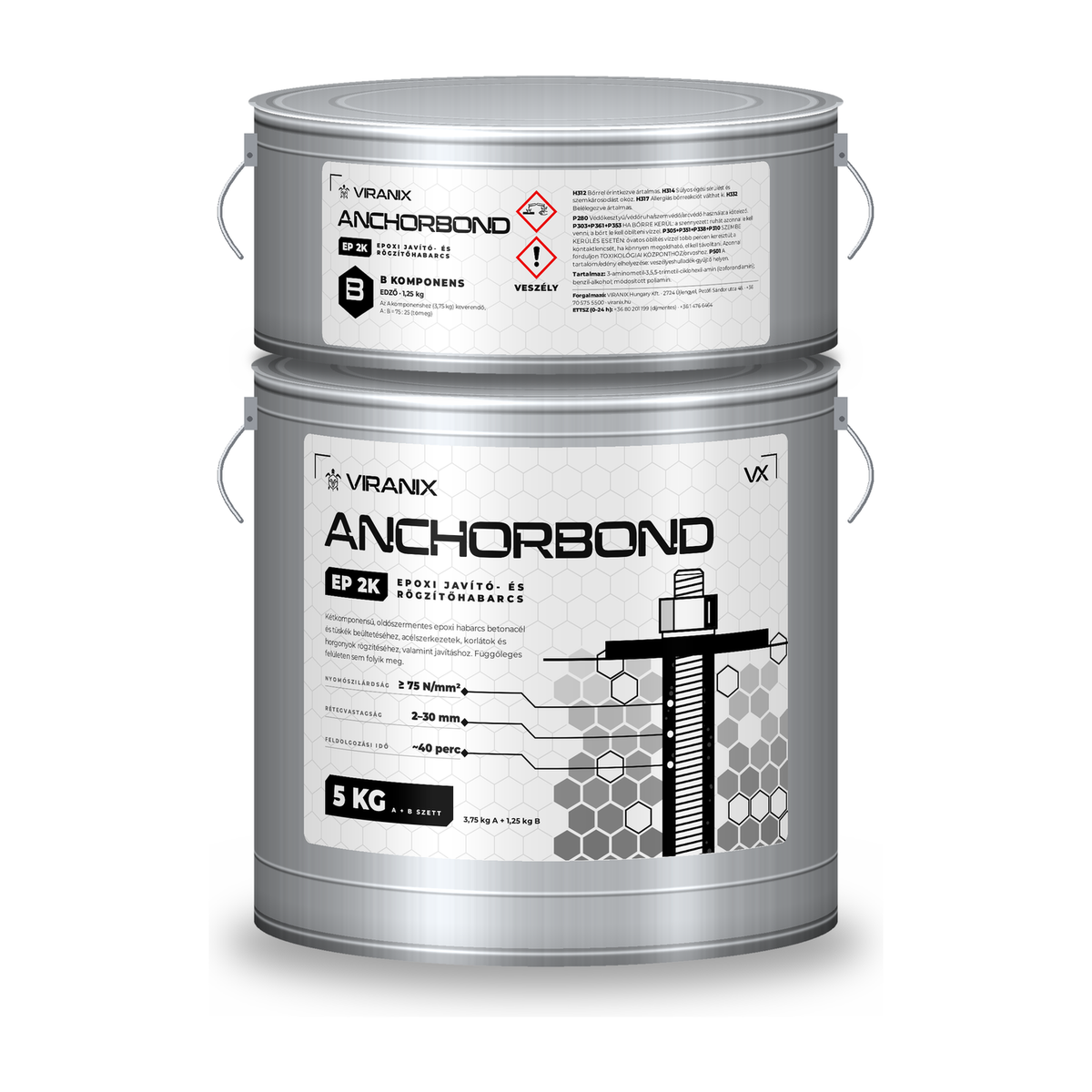
Two-component, solvent-free epoxy mortar for setting rebar and dowels, anchoring steel structures, railings and anchors, and for repairs.
- Packaging:
- 5 kg
You can calculate how much you need per hole or per area. Go to the calculator
Application guide and technical data further down the page
Működés
How to bond in rebar
ANCHORBOND EP 2K is a two-component, solvent-free epoxy mortar. Its paste consistency means it does not sag, and once cured it reaches a compressive strength of at least 75 N/mm² after 7 days.
Felhasználás
Where can you use it?
For anchoring, installation and repair work on horizontal and vertical surfaces. It is also resistant to petroleum products, acids and alkalis, making it reliable in industrial environments.
-
Setting rebar and dowels
In concrete and stone walls, also for threaded rods.
-
Anchoring steel structures
Bonding metal and steel structural elements to concrete.
-
Railings and anchors
Fixing railings and anchor elements.
-
Bridges, viaducts
Fixing vibration-damping elements.
-
Expansion joint tapes
Bonding the edges of DILITAPE and other expansion joint tapes.
-
Repairing breakouts
Repairing defects and breakouts in thicknesses of 2–30 mm.
Kivitelezés
Application step by step
Epoxy only bonds properly to clean, sound, dust-free surfaces, so cleaning the holes is just as important as accurate mixing.
-
Prepare the substrate
The surface must be sound, clean and free of dust and grease. Remove loose parts and blow out or vacuum the holes.
-
Mix the two components
Pour the entire B component into A and mix with a low-speed mixer for at least 2 minutes until a uniform gray color is achieved. Transfer to a clean container and mix for approx. 1 more minute without entraining air.
Tipp The mixing ratio is 75 : 25 (by weight), so mix the components in exactly this proportion.
-
Fill the hole or apply
Work with a spatula, trowel or dispensing gun in thicknesses of 2–30 mm. Fill holes from the bottom up.
Tipp Use the mixed material within approx. 40 minutes (23 °C).
-
Set the rebar
Push the rebar or threaded rod into the mortar-filled hole with a twisting motion. Mortar must emerge from the hole.
-
Let it cure
Overcoatable after 8–24 hours (23 °C, 55% relative humidity). Full load only after full cure, after 7 days.
Calculator
How much mortar do you need?
For anchoring we calculate the gap between the hole and the rebar; for surface repairs, the layer thickness. Density: 1.70 g/cm³, consumption: approx. 1.7 kg/m² per mm.
Enter the hole dimensions and number of holes.
- Material required
- –
- Recommended quantity
- –
- Estimated price
- –
The calculation gives a theoretical quantity without waste. One kit is 5 kg (3.75 kg A + 1.25 kg B).
Adatlap
Technical data
- Product structure
- Two-component, paste-consistency, high-strength epoxy resin
- Color
- Gray (mixed)
- Density
- 1.70 ± 0.05 g/cm³
- Mixing ratio (A : B)
- 75 : 25 (by weight), 3.75 kg A + 1.25 kg B
- Layer thickness
- 2–30 mm
- Working time
- approx. 40 minutes (23 °C)
- Overcoatable
- after 8–24 hours (23 °C, 55% relative humidity)
- Full cure
- 7 days
- Compressive strength
- 1 day: ≥ 30 N/mm², 7 days: ≥ 75 N/mm²
- Flexural tensile strength
- 1 day: ≥ 17 N/mm², 7 days: ≥ 25 N/mm²
- Bond strength
- 1 day: ≥ 3.5 N/mm², 7 days: ≥ 3.0 N/mm²
- Material consumption
- approx. 1.7 kg/m² per mm
- Application temperature
- between +10 and +35 °C
- Chemical resistance
- Resistant to petroleum products, acids and alkalis
- Application tool
- Spatula, trowel, dispensing gun
- Storage
- 12 months, unopened, in a dry place between +5 and +25 °C
- Packaging
- 5 kg kit (3.75 kg A + 1.25 kg B), in two metal buckets
Safe use
Signal word: Danger
- Corrosive
- Irritant
- Health hazard
- Environmental hazard
- Component A (resin)
- H315Causes skin irritation.
- H317May cause an allergic skin reaction.
- H319Causes serious eye irritation.
- H334May cause allergy or asthma symptoms or breathing difficulties if inhaled.
- H335May cause respiratory irritation.
- H411Toxic to aquatic life with long lasting effects.
- Component B (hardener)
- H312Harmful in contact with skin.
- H314Causes severe skin burns and eye damage.
- H317May cause an allergic skin reaction.
- H332Harmful if inhaled.
- Precautionary measures
- P260Do not breathe vapors/spray.
- P273Avoid release to the environment.
- P280Wear protective gloves/protective clothing/eye protection/face protection.
- P303+
P361+ IF ON SKIN (or hair): Take off immediately all contaminated clothing. Rinse skin with water.P353 - P305+
P351+ IF IN EYES: Rinse cautiously with water for several minutes. Remove contact lenses, if present and easy to do. Continue rinsing. Immediately call a POISON CENTER/doctor.P338+ P310 - P342+
P311 If experiencing respiratory symptoms: Call a POISON CENTER/doctor. - P501Dispose of contents/container at a hazardous waste collection point in accordance with local regulations.
Component A contains: bisphenol-A-based epoxy resin (average molecular weight ≤ 700). Component B contains: 3-aminomethyl-3,5,5-trimethylcyclohexylamine (isophorone diamine), benzyl alcohol, modified polyamine.
Can be removed with acetone before curing. Hungarian Toxicological Information Service (ETTSZ, 0–24 h): +36 80 201 199 (toll-free), +36 1 476 6464.
GYIK
Frequently asked questions
Can't find the answer? Call us at +36 70 575 5500 or write to info@viranix.hu.
What can it be used for?
For setting rebar, dowels and threaded rods in concrete and stone walls; anchoring steel structural elements, railings and anchors; fixing vibration dampers on bridges and viaducts; bonding the edges of expansion joint tapes; and repairing breakouts in thicknesses of 2–30 mm.
How much mortar is needed per hole?
The volume of the gap between the hole and the rebar must be filled; the mortar density is 1.70 g/cm³. For example, a 16 mm hole with 12 mm rebar at a depth of 120 mm needs approx. 18 g per hole. You can calculate the exact quantity with the calculator.
How large an area does one 5 kg kit cover?
Consumption is approx. 1.7 kg/m² per mm, so one kit covers approx. 2.9 m² at 1 mm thickness or approx. 1 m² at 3 mm.
How long does the mixed material remain workable?
Approx. 40 minutes at 23 °C.
When can it be loaded?
Overcoatable after 8–24 hours (23 °C, 55% relative humidity); it can take full load after full cure, after 7 days.
How do I mix it?
Pour the entire B component into A and mix with a low-speed mixer for at least 2 minutes until a uniform gray color is achieved. Then transfer to a clean container and mix for approx. 1 more minute without entraining air.
Can it be used on vertical surfaces?
Yes. Its paste consistency means it does not sag and stays in place on both horizontal and vertical surfaces.
At what temperatures can it be applied?
Between +10 and +35 °C.
Is it chemically resistant?
Yes. It is also resistant to petroleum products, acids and alkalis, so it can be used reliably in industrial environments.
What can tools be cleaned with?
It can be removed with acetone before curing.
What protective equipment is needed?
Protective gloves, protective clothing, eye protection and face protection are mandatory; do not breathe vapors or spray.
Rendszer
You may also need
Request a quote for larger jobs
Anchoring many holes, railings or steel structures? Tell us the number and size of the holes and we will help you calculate the material requirement.