

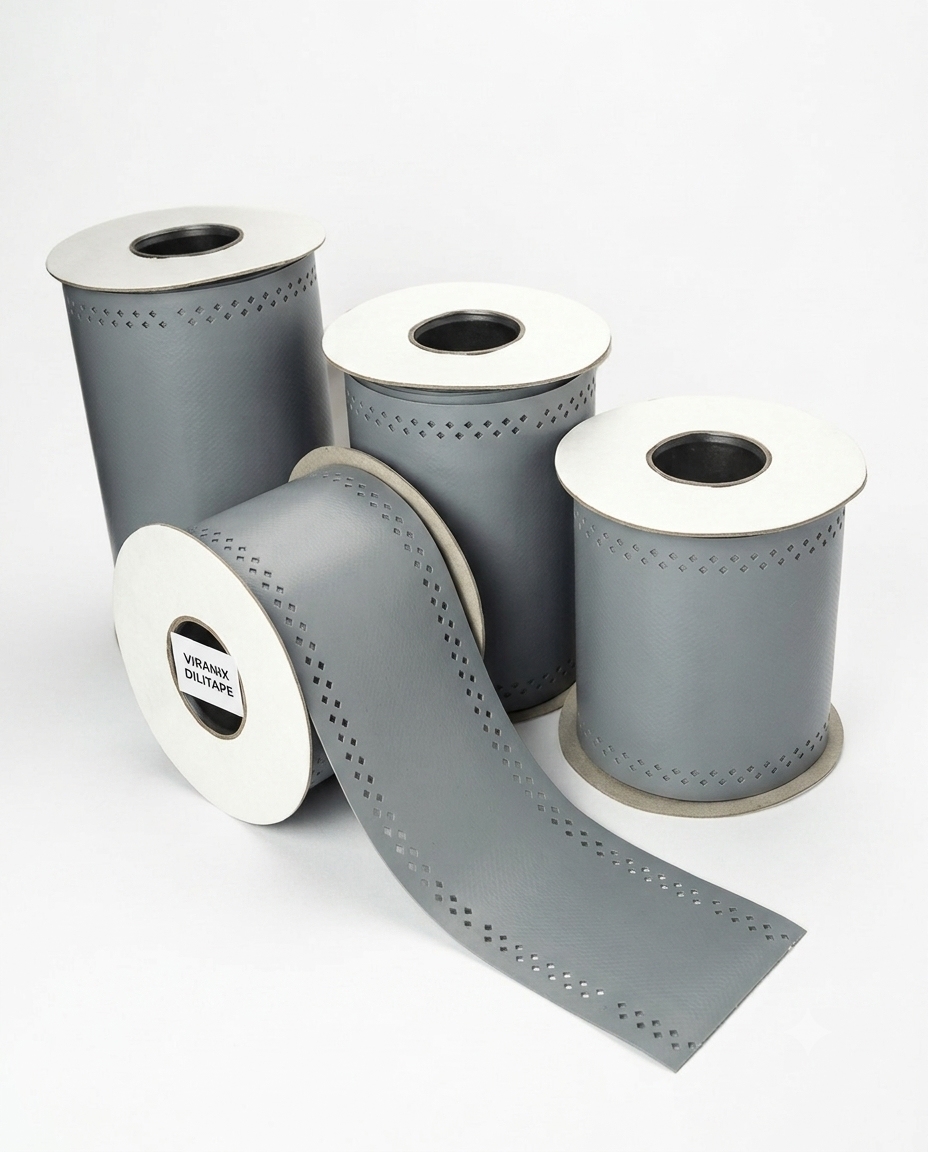
DILITAPE – Thermoplastic Expansion Joint Tape
Thermoplastic expansion joint tape for permanently sealing moving structural joints. With up to 1000% elongation it follows the movement of the joint, helping keep the stone carpet or waterproofing laid over it free of cracks.
- Width:
- 20 mm
Material consumption: 1 m of tape per linear meter of joint. The quantity is the tape length in meters.
Installation guide and technical data further down the page
Felhasználás
Where to use it
For joints where the structure may move due to thermal expansion, settlement or load.
-
Building expansion joints
For horizontal, vertical and overhead applications.
-
Concrete–concrete and concrete–wall joints
Permanent sealing of connection joints.
-
Terrace, foundation and floor connections
Sealing of moving connections.
-
Building sections prone to settlement
Moving joints between building sections.
-
Dividing large covered areas
For stone carpet and other coverings, above approx. 25 m².
-
With edge protection and closing profiles
Combined with edge protection and closing profiles.
Kivitelezés
Installation step by step
The tape is bonded to the substrate at its edges while its center moves freely. This is what determines whether the covering above stays crack-free.
-
Prepare the substrate
The substrate must be dry, clean and free of loose parts. Thoroughly remove dust, oil, grease, paint, cement laitance and rust, and repair breakouts and cracks first, for example with VIRANIX REPAIR 800 R4.
Tipp On damp surfaces, carry out an adhesion test first.
-
Apply the epoxy adhesive
Mix the two-component epoxy adhesive at low speed until homogeneous, then use a trowel to apply it approx. 1.0–1.5 mm thick to both edges of the joint: at least 40 mm wide for a 20 cm tape and at least 50 mm wide for a 30 cm tape.
-
Lay the tape over the joint
Lay the tape into the fresh adhesive so that its center sits exactly over the moving gap, with a small free loop, then press it down over the entire surface with a roller.
Figyelem If you bond the middle section of the tape rigidly over the moving joint, it cannot work and the covering above may crack.
-
Bond the edges from above as well
Apply 1.0–1.5 mm of adhesive to both edges of the tape from above as well, overlapping the tape by at least 20 mm. Once cured, the covering or waterproofing can be applied according to its own instructions.
Tipp The adhesive cures more slowly in cold weather and faster in warm weather.
Adatlap
Technical data
- Material
- Thermoplastic
- Color
- Gray
- Thickness
- 1.00 mm
- Shore A hardness
- 87
- Elongation at break
- 1000%
- Tensile strength
- 14.0 N/mm²
- Temperature resistance
- −30 °C – +90 °C
- Water pressure resistance
- ≥ 4 bar (DIN EN 1928)
- Weight per area
- approx. 930 g/m²
- UV resistance
- min. 6,500 hours
- Fire class
- B2
- Material consumption
- 1 m of tape / 1 linear meter of joint
- Packaging
- 15, 20, 25 and 30 cm wide, 20 m rolls
- Storage
- 12 months, unopened, in a dry place, +5 °C – +25 °C
Safety information
The product is not classified as hazardous. Follow the usual occupational safety rules when using it.
The epoxy adhesive used for fixing is subject to its own safety instructions.
GYIK
Frequently asked questions
Can't find the answer? Call us at +36 70 575 5500 or write to info@viranix.hu.
What is DILITAPE for?
For permanently sealing moving structural joints where the structure may move due to thermal expansion, settlement or load. The tape follows the movement without tearing, helping keep the stone carpet or waterproofing above it free of cracks.
How much tape do I need?
1 m of tape per linear meter of joint. The quantity is the tape length in meters.
What should it be fixed with?
With a two-component epoxy adhesive, along its edges. VIRANIX ANCHORBOND EP 2K is also suitable for this. The center of the tape stays free so that it can move.
Can it be used outdoors?
Yes. It is UV- and weather-resistant (min. 6,500 hours UV resistance) and retains its elasticity between −30 °C and +90 °C.
How much water pressure can it withstand?
At least 4 bar (DIN EN 1928).
Should I use this for static cracks too?
For non-moving, static cracks and connections, use the CRACKBAND self-adhesive tape. DILITAPE is designed for moving expansion joints.
Rendszer