

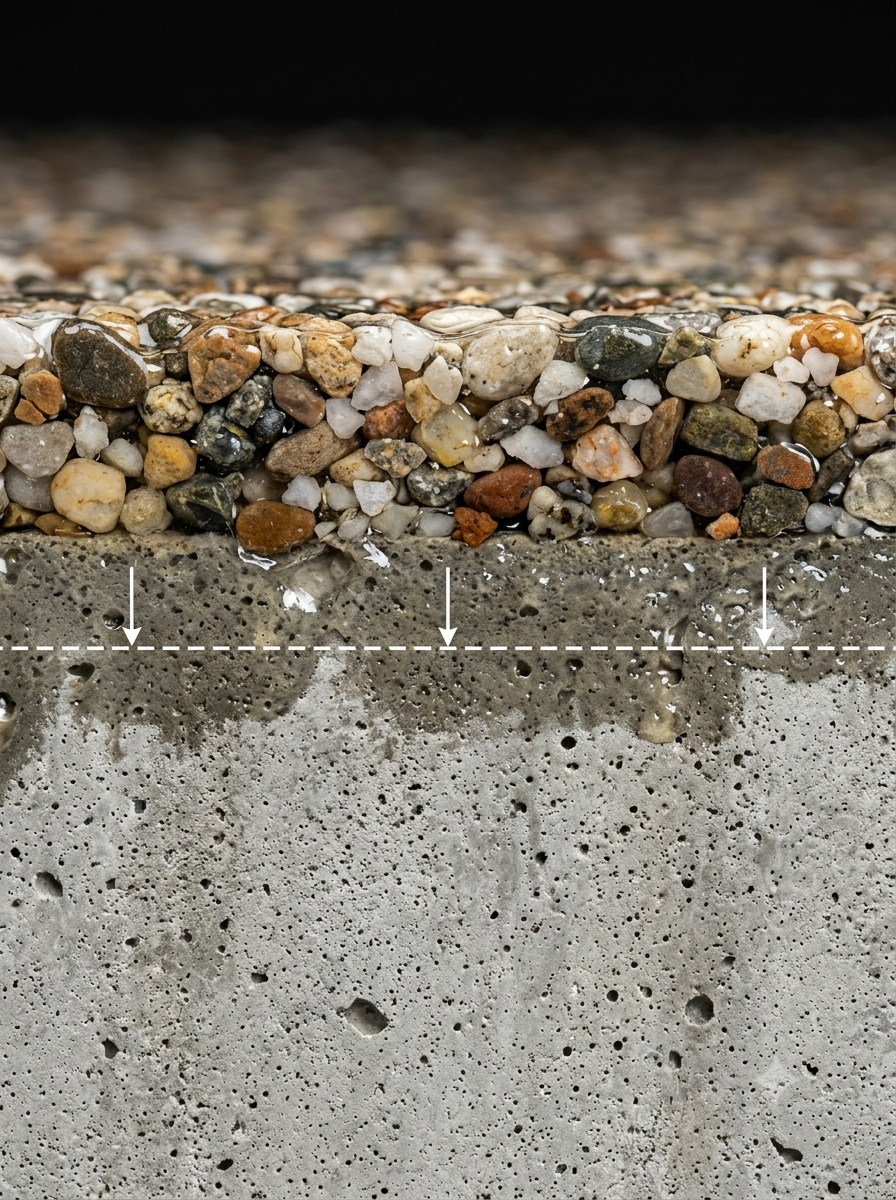
What really makes a stone carpet flooring strong?
It's not the hardness of the cured material that gives it durability, but how the system bonds to the substrate. With concrete numbers on binder content, curing time, and the most common misconceptions.
Many people believe that the strength and durability of a stone carpet flooring comes from the "hardness" of the binder — as if it were a solid, cast material that needs to be as rigid as possible to perform well. In reality, the strength of the VIRANIX system doesn't lie there, but in something far more important: how the system bonds to the substrate, and the fact that the curing process must be judged under real-world conditions, not in a snapshot pulled out of a lab.
Stone carpet flooring never functions as a self-supporting material. The strength of the system doesn't come from how hard the material is once cured on its own — it comes from how it behaves in its final location, bonded to a stable substrate, after the full curing time has elapsed.
01Stone carpet is not a self-supporting material
Stone carpet flooring is always designed as a layered flooring system that works together with a stable, load-bearing substrate (concrete, screed, an existing stable floor). In its final location it is never in a "self-supporting" state — it always performs its function together with the substrate.
This matters because a sample poured into a mold or tray, without any carrier surface, cannot demonstrate the system's real performance at all. There's nothing for it to bond to, nothing to adhere to — this isn't a limitation of the product, it's a limitation of the test method.
02Why does it matter that the material actually bonds into the concrete?
The durability of any flooring ultimately comes down to a single question: how long do the coating and the substrate stay together under load, temperature fluctuation, and moisture? This bond can essentially form in two different ways, and there's a real, practical difference between them.
Surface adhesion vs. mechanical bonding
Concrete and screed are not solid, homogeneous materials — at the microscopic scale their surface is a porous structure riddled with capillary channels. This pore system is what determines how a coating applied on top of it can actually connect with it:
|
Surface film formation
Dense, high-solids materials that skin over quickly tend to stay on the surface before they cure. The bond here is predominantly adhesive — the coating "sticks" to the surface but barely penetrates the pore structure. This type of bond is more sensitive to shear forces, temperature fluctuation, and water undermining the surface: if adhesion fails at one point, the crack tends to spread across the entire surface plane.
|
Mechanical bonding (VIRANIX principle)
The lower-viscosity, water-based binder partially penetrates the upper pore layer of the substrate during the early stage of curing, before it solidifies. The cured binder then literally "grips" into the microstructure of the concrete — this is a mechanical interlock that connects the two materials not just on the surface, but spatially, through a thin transition layer.
|
What does this mean in practice?
The principle of mechanical interlock isn't a VIRANIX-specific invention — it's the basis of every serious industrial bonding-bridge and impregnation technology (for example, the penetrating primers used for surface treatment of concrete work on the same principle). In practice, this brings the following measurable benefits:
- Larger bonding area: since the binder is present not only on the surface of the concrete but also within its upper pore layer, the actually connected surface area is many times larger than a flat, two-dimensional contact plane.
- More resistant to shear stress: a layer that only adheres on the surface can more easily "pop off" under lateral load (e.g. a rolling wheel, friction), because the entire force concentrates on a single plane. In a more deeply anchored system, this force is distributed through the pore layer.
- Less sensitive to local defects: if a surface film coating gets damaged or delaminates at one point, that failure tends to spread "zipper-like" because there's nothing to stop the crack from propagating in the plane. In a mechanically bonded system, local damage spreads less, because the "roots" reaching into the substrate hold the surface independently of one another.
- Better co-movement under temperature fluctuation: concrete and the layer built on top of it have different coefficients of thermal expansion. If the bond is only superficial, this difference shows up as concentrated shear stress at the interface. A more deeply anchored, flexible binder distributes this stress better, because it transfers movement not across one sharp plane, but through a transition zone.
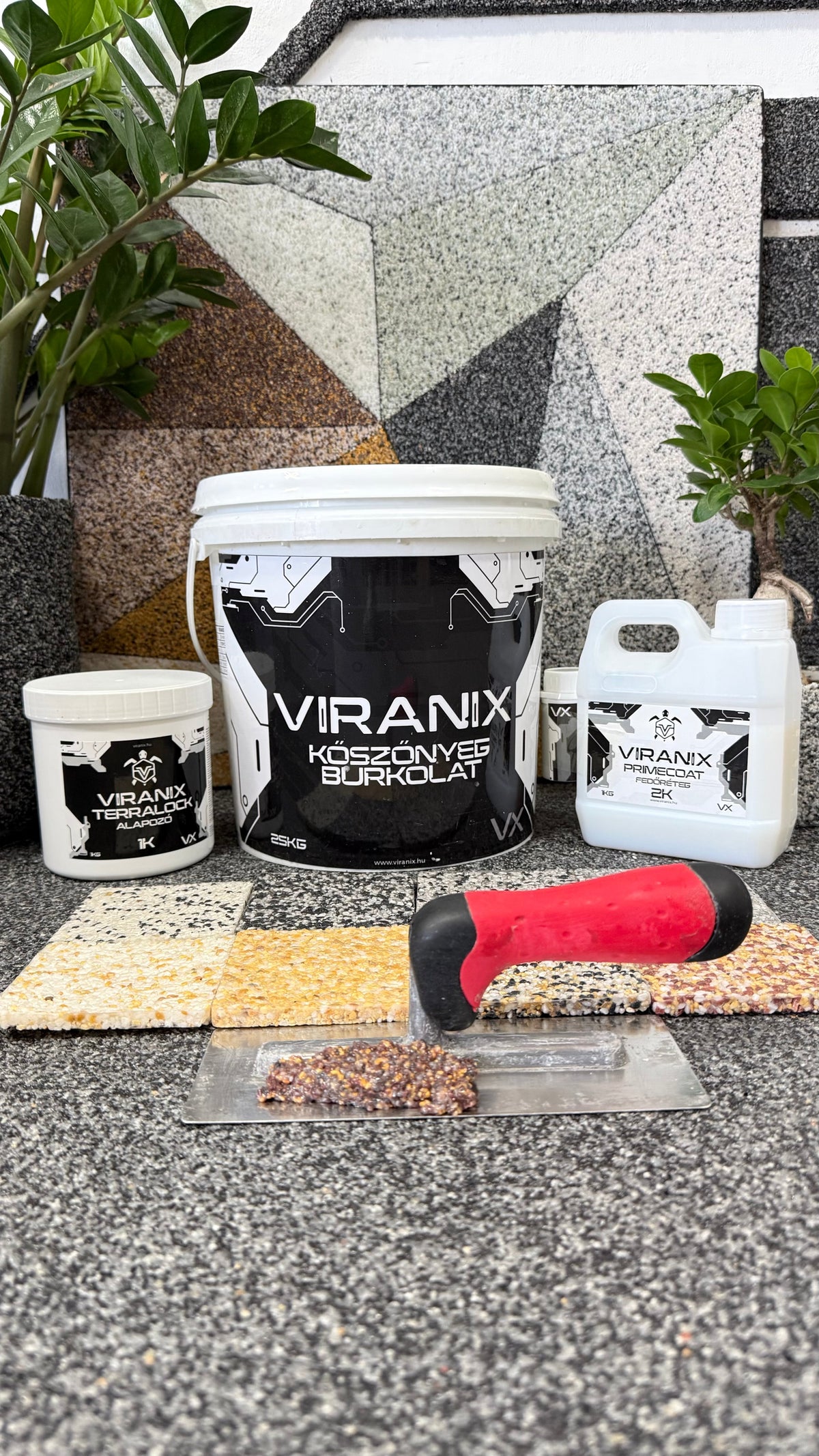
This is also why, in the VIRANIX system, priming (TerraLock 1K) is not a step that can be skipped — it's one of the most important elements of the system: this is the layer that prepares the actual mechanical bond before the stone carpet layer is applied.
This is why a test on a non-adhesive surface is misleading
If a material is poured into a silicone mold or onto another deliberately non-adhesive (release-type) surface, the mechanical interlock described above simply cannot form — there are no pores for the binder to penetrate. This doesn't measure how good the system is, it measures how poorly it sticks to a surface whose entire function is to make sure nothing sticks to it. Such a demonstration therefore doesn't give any information about the product's performance — only about the properties of silicone.
03Binder content, in numbers
The binder content of stone carpet systems available on the market can vary significantly. This directly affects flexibility, crack-bridging, and long-term load-bearing capacity.
| System type | Binder / 25 kg | Structural character | Crack-bridging |
|---|---|---|---|
| VIRANIX water-based system | ~6 kg | Flexible, follows thermal expansion | Good |
| Typical market 2K epoxy / PU | ~1.1–1.5 kg | Stiffer, less flexible | Limited |
The market values in this table are indicative and may vary by manufacturer. The VIRANIX figure comes from our own product specification.
04Curing time isn't a matter of seconds
One of the most common misunderstandings is treating a stone carpet sample, minutes after application, as if it already showed its final state. For water-based systems, the full curing time depends on layer thickness — the thicker the layer, the longer it takes for moisture to evenly leave and the binder to solidify throughout the full cross-section.
| Layer thickness | Walkable | Full cure (loadable) |
|---|---|---|
| 2–4 mm (wall / plinth) | 24–48 h | 4–5 days (indoors) |
| 6 mm (pedestrian) | 24–48 h | 4–5 days |
| 8+ mm (vehicle) | 24–48 h | 5–7 days |
| ~10 mm (1 cm) | 24–48 h | 5–7 days |
A recording made minutes after application — whether it's a sample poured into a tray or a freshly applied section of a terrace — technically does not even show the final material, since the curing process is still very much underway at that point.
05Why a "mold test" isn't representative
If someone tries to judge a stone carpet product purely by pouring it into a mold or tray without a carrier surface (adhesive substrate), then watching how well it "holds together" on its own, that disregards the entire point of the system.
|
Mold / tray test
• No adhesive, load-bearing substrate
• The surface is deliberately non-adhesive • Curing time is often not waited out • No primer / bonding bridge • No topcoat, even where it would be needed |
Real-world application
• Stable, load-bearing substrate
• Dust-free, prepared surface • TerraLock 1K primer / bonding bridge • Specified layer thickness • Full curing time + topcoat |
06How is a rock-solid layer system built up?
Durability doesn't come from a single step, but from the entire process together.
07The topcoat: the system doesn't end at the stone carpet layer
In the earlier sections we explained in detail why it's essential for the stone carpet layer to actually bond into the substrate. However, this mechanical connection is only one half of the system — the other, equally important element is what protects this surface from everyday wear and tear. That's what the topcoat is for.
Why isn't the topcoat an optional extra?
The stone carpet layer on its own, without a topcoat, already gives a stable, well-bonded surface — but the micro-pores between the aggregate remain open. This means the surface stays directly exposed to dirt, moisture, and mechanical wear. The job of the PRIMECOAT topcoat is to seal these pores and create a continuous, resistant top layer over the stone carpet.
|
PRIMECOAT 1K — Indoor
A water-based sealant with an aesthetic and surface-protective role. Dedusts and adds a sheen to the surface, and makes daily cleaning easier. Recommended where there's no sustained water exposure or extreme use.
|
PRIMECOAT 2K — Outdoor / vehicle
A two-component PU topcoat that fully seals the pores and provides increased mechanical and chemical resistance. Required for outdoor use and for vehicle load alike, on its own — this is not an optional extra, but a fundamental requirement of the system logic.
|
What exactly does the topcoat protect?
- The mechanical bond itself: a sealed surface prevents water from getting into the pores between the aggregate and, from there, down to the substrate-binder interface, which over the long term could weaken the interlock described earlier.
- Frost resistance: if the surface isn't sealed, water trapped in the pores can freeze in winter and expand, exerting a stress on the surrounding aggregate. The 2K topcoat eliminates this risk.
- Chemical and mechanical wear resistance: in car parking areas, oil, road salt, and tire friction all mean increased stress, which a sealed, PU-based surface handles far better than an open-pore version.
- Cleanability: on a sealed surface, dirt can't work its way deep into the pores, making everyday cleaning (sweeping, mopping) far more effective.
This is precisely why we never consider the VIRANIX system "complete" without a topcoat for outdoor applications — whether it's a terrace, a walkway, a driveway, or any surface exposed to precipitation and weather, the PRIMECOAT 2K topcoat is essential. The stone carpet layer provides the mechanical bond to the substrate, and the topcoat ensures that this bond stays intact over the long term.
08Frequently asked questions
Because the flexible, water-based binder follows thermal expansion and minor substrate movement — this is a designed property, not a defect. In the uncured state, this flexibility is even more pronounced, since the binder hasn't yet reached its final strength.
Because the system was designed for a stable, sufficiently rough, adhesion-suitable substrate. A non-adhesive surface — such as silicone — is deliberately made so that nothing bonds to it, regardless of the product's brand.
No. "Stone carpet" is a generic, descriptive name for the product category, used by several manufacturers for their own, differently formulated systems. There's no official, mandatory standard prescribing what binder or thickness a product must have to qualify as a stone carpet.
Yes. The topcoat is an integral, designed part of the system — it doesn't change the nature of the base layer, it just adds increased water resistance and mechanical resistance on top of it.
Have a question about the layer system or installation?
We provide personalized guidance and quotes for any surface type.
+36 70 575 5500 viranix.hu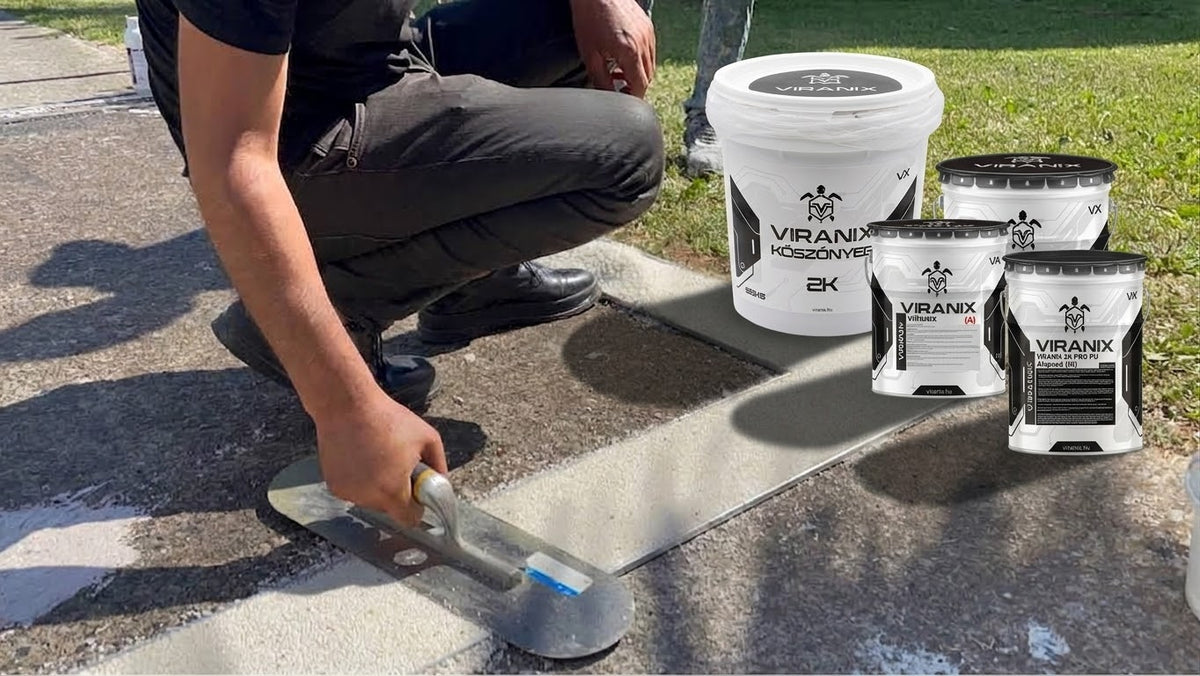
Zdieľať:
2. Základný náter pod Viranix kamenný koberec – profesionálny postup, merateľná kvalita
VIRANIX 1K Kőszőnyeg PRIMECOAT 2K fedőréteg: lépésről lépésre
1 komentár
Szép napot! M2 ár érdekel ? Köszönöm.